

Abstract
Objective: Although chronic pain is a significant health issue that affects quality of life and psychosocial well-being, the effectiveness of dietary patterns rich in antioxidants in managing this condition is emphasized. Given that individuals with chronic pain require information about nutrition, this study aimed to determine the effectiveness of Mediterranean diet education on nutritional status and health related qualiy of life in the management of chronic pain.
Materials and Methods. The study included female participants (n=15) diagnosed with primary or secondary chronic pain. To evaluate the effectiveness of the education provided to participants on the Mediterranean diet in the management of chronic pain, Mediterranean diet adherence screener, anthropometric and body composition measurements, visual analogue scale scores, and quality of life scores were assessed at baseline and after an eight-week follow-up were compared.
Results: Mediterranean diet adherence screener scores increased after the training, and as a result of the changes in dietary behavior brought about by the training, vegetable protein intake increased while animal protein intake decreased (p<0.05). Other macro-nutrient changes also showed a profile consistent with the Mediterranean Diet; participants experienced reductions in waist circumference and body fat percentage, as well as improvements in the quality-of-life subdimensions of social functioning, pain, vitality, perceived general health, and visual analogue scale scores (p<0.05).
Conclusion: Mediterranean diet education has been shown to be an effective tool in pain management for patients with chronic pain. Further randomized controlled trials with larger sample sizes and longer follow-up periods are recommended to confirm these findings.
Keywords: chronic pain, dietary habits, Mediterranean diet, nutrition education, pain
Main Points
- Regular telephone follow-ups regarding education on the Mediterranean diet and adherence to it significantly increased adherence to the Mediterranean diet, and the accompanying changes in dietary behavior.
- Nutrition training being an accessible, feasible, and low-cost intervention may offer significant opportunities for the development of community-based programs for chronic pain management.
- Accompanying changes in dietary behavior were found to have positive effects on anthropometric measurements, quality of life, and pain intensity.
Introduction
Chronic pain (CP) is a complex health issue defined by the International Association for the Study of Pain (IASP) as pain lasting longer than three months; reduces the quality of life for millions of people worldwide, disrupts their psychosocial balance, and leads to significant loss of workforce.1 This condition, negatively affects individuals’ physical and mental well-being.2 CP also results in significant socioeconomic costs. The global prevalence of CP has been reported to be in the range of 20%–30%.3,4 The extent to which individuals in communities are affected by CP also varies, and higher prevalence rates identified in females.4
Currently, pharmacological approaches are predominantly preferred for the management and treatment of pain, but interest in non-pharmacological approaches to pain management is steadily increasing.3 Nutritional therapies are considered a strategic approach to pain management through, can improve patients’ overall health, alleviate systemic inflammatory processes, and consequently increase the effectiveness of pain management.5
The Mediterranean Diet (MD)—a dietary pattern characterized by the use of olive oil as the primary source of fat, a high proportion of plant-based foods, and limited consumption of red meat—holds an important role among healthy eating habits and has significant potential in the management of CP, due to its anti-inflammatory and antioxidant properties.6 More information is needed regarding the impact of nutritional interventions on pain management in people experiencing pain.7 This study aimed to determine the effectiveness of MD education and accompanying dietary behavioral changes in CP management.
Materials and methods
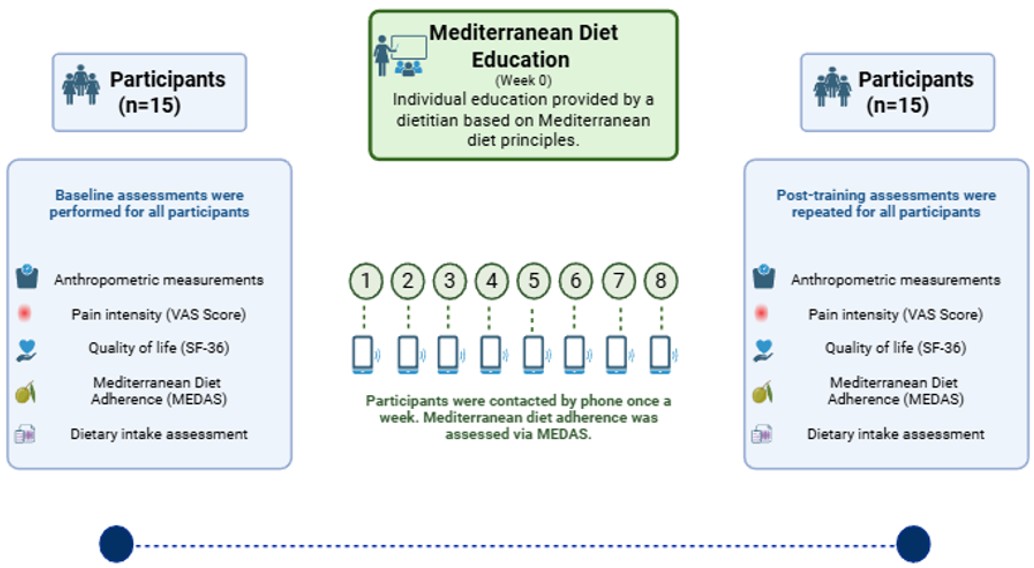
This study was designed to evaluate the effects of adherence to a MD pattern—achieved through MD training—on anthropometric measurements, body composition, pain intensity, and quality of life among females with CP. The study design is presented in Figure 1.
Study participation
This study, which evaluated the effects of nutrition training related to the Mediterranean diet—an anti-inflammatory dietary model for chronic pain management—included female participants aged 19–64 who sought treatment at the Physical Therapy and Rehabilitation Unit and had a diagnosis of primary or secondary chronic pain, such as “rheumatoid arthritis, arthrosis, osteoarthritis, myofascial pain, low back pain, neck pain, scleroderma, fibromyalgia, or migraine (ICD-11; MG30.0, MG30.3)”1,8,9 and who volunteered to participate. Participants who were following any diet, taking vitamin or mineral supplements, have been diagnosed with an acute illness, were cancer patients, were addicted to drugs or alcohol, were pregnant or breastfeeding, were taking vasoactive, contraceptive, anticoagulant, or antithrombotic medications, or had a pacemaker or prosthetic device were excluded.
Data collection tools
A survey form includes sociodemographic characteristics, health information, anthropometric measurements, and dietary habits.
Anthropometric and body composition measurements:
Height (cm): Height was measured by portable stadiometer (HR-0001 Leicester) when participants maintained the Frankfort horizontal plane position and at the end of deep inhalation.
Weight and body composition: Weight was assessed using a Tanita BC 401 device, under standardized conditions.10 The device automatically calculated body composition metrics, including fat-free mass (kg), percentages of body fat, total body water, and the abdominal obesity rate.
Body mass index (BMI): BMI was derived body weight in kilograms divided by height in meters squared.10
Neck circumference (cm): Neck circumference was measured by a non- stretchable plastic tape measure. The measurement was taken parallel to the line inferior to the thyroid cartilage.10
Waist circumference (cm): Waist circumference was measured at the midpoint between the lower costal margin and the iliac crest using a non-elastic plastic measuring tape positioned around the abdomen.10
Visual Analogue Scale (VAS): Pain intensity was evaluated using the VAS, which consists of a 10-cm line anchored by “0: no pain” and “10: very severe pain”. Higher VAS scores reflect greater pain severity.11
SF-36 Quality of Life Scale: The SF-36 was developed in 1991 by the Medical Outcomes Study team to assesses individuals’ functional status and well-being. Consists of a total of 36 items across eight subdimensions. A total score on a scale of 0 to 100 is calculated separately for each sub-dimension; physical and social functioning, physical and emotional roles, general and mental health, pain and vitality (energy). A total score closer to 100 indicates a high quality of life.12 The SF-36 was administered to participants at the baseline and final interviews.
Mediterranean diet adherence screener (MEDAS): To evaluate adherence to the MD, the 14-item MEDAS which was established by Martínez-González et al. via the PREDIMED (Prevención con Dieta Mediterránea) consortium.13 While Schröder et al.,14 managed its primary validation, its Turkish linguistic and statistical validation was validated by Bekar et al. in 2023, yielding favorable reliability metrics (r = 0.750, p < 0.001; ICC = 0.749, p < 0.001).15
Training on the Mediterranean Diet: Patients who presented to the Physical Medicine and Rehabilitation Unit and had the specified ICD codes were referred to the Nutrition and Dietetics Outpatient Clinic. The researchers conducted the interviews and dietary education sessions at there. Participants received an individualized MD education session delivered face-to-face by a dietitian at baseline. The education covered the fundamental principles of the MD.16 Educational materials in Turkish were provided to facilitate adherence (Supplementary Materials 1–2). Following these participants were contacted by telephone once weekly for eight weeks. During each call, adherence to the MD principles was assessed (Supplementary Materials 3), barriers to compliance were discussed, and motivation was provided.
Dietary recall: Dietary intake was evaluated using a 24-hour dietary recall administered by a researcher dietitians at baseline and at the end of the 8-week period. Daily energy, nutrient intakes and ORAC levels were analyzed using the full version of the Nutrition Information System (BeBiS) software (version 9.0).
Statistical analyses
The data obtained from the study were analyzed and interpreted using the SPSS 31.0. The data were tested for normality using the Shapiro-Wilk test, and for the comparison of two dependent groups, the paired t-test was used for those that followed a normal distribution. Effect sizes were assessed using Hedge’s g test. Given the exploratory nature of the study and the assessment of outcomes across distinct clinical and nutritional domains, no formal adjustment for multiple comparisons was applied. Exact p-values are reported to facilitate interpretation. In all statistical analyses, p <0.05 was considered statistically significant.
Results
The mean age of the participants included in the study (n=15) was 29.1±10.05 years (21.0–47.0), and the vast majority (93.3%) held a bachelor’s degree. Participants reported more than one CP diagnosis, and the most common clinical diagnosis was migraine at 73.3% (Table 1).
| *More than one chronic pain diagnosis has been identified in a person. | |
| Table 1. Sociodemographic characteristics and dietary habits of participants. | |
| Variables |
|
| Age (years) |
|
| Education level | |
| High school or below |
|
| Bachelor’s degree |
|
| Chronic pain diagnosis* | |
| Migrain |
|
| Rheumatoid arthritis |
|
| Fibromyalgia |
|
| Diagnosis period/disease duration (years) |
|
The changes in participants’ MEDAS scores before and after the training, along with the results of the statistical analysis, are shown in Figure 2. According to the analysis of paired samples, MEDAS scores increased significantly after the nutrition (p<0.001) Adherence to the MD increased after the training in all participants. Table 2 presents comparative data on participants’ daily energy and macro- and micronutrient intakes at baseline and after the training. No statistically significant change in participants’ total energy intake (p>0.05). Significant increase in vegetable protein intake (p=0.022,), while intake of animal protein decreased (p = 0.030). Even though the changes observed in vitamin A, vitamin E, vitamin C, folate, magnesium, iron, zinc, and total antioxidant capacity were favorable, they were not statistically significant (p>0.05).
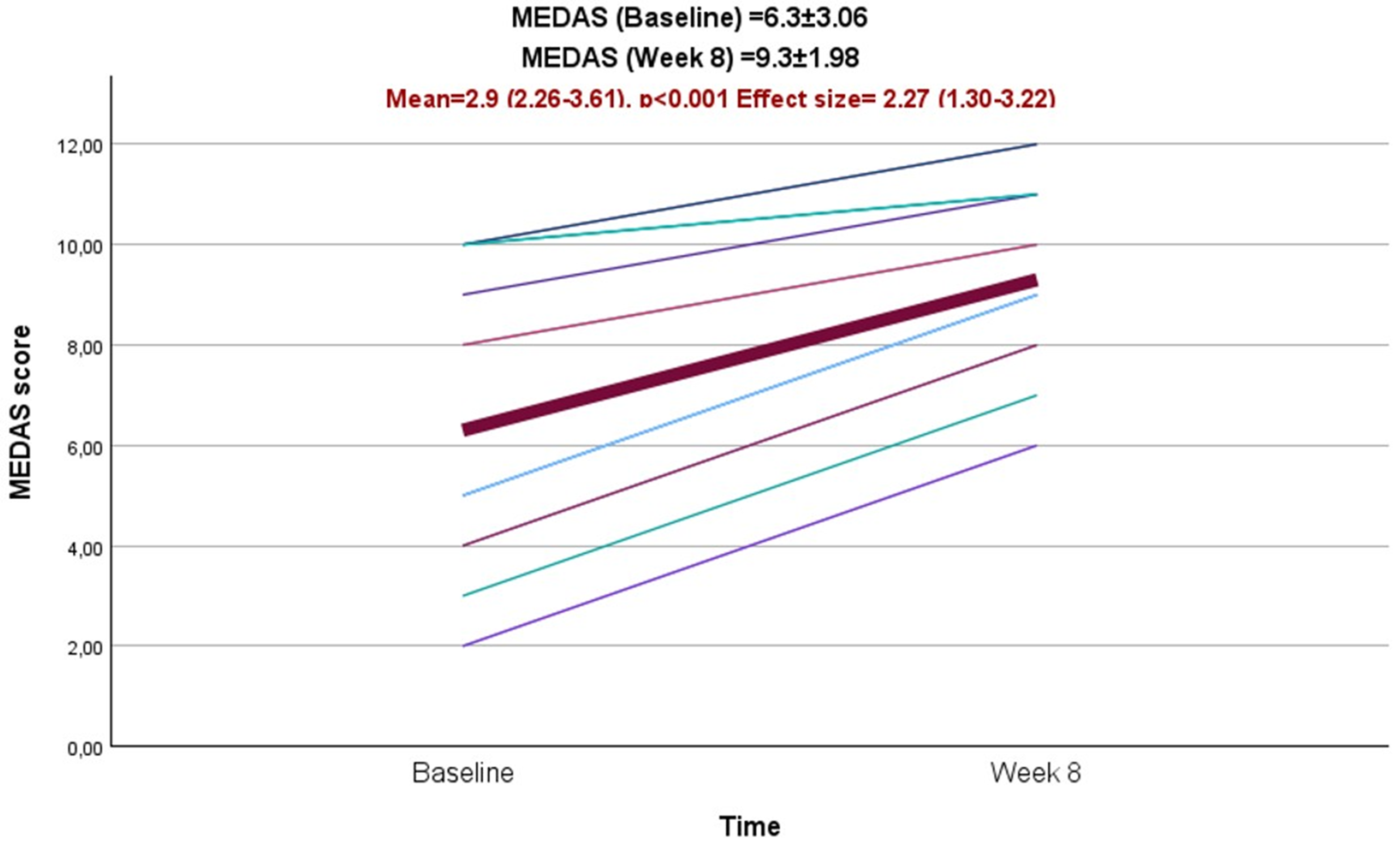
MEDAS (Mediterranean Diet Adherence Screener).
| MUFA: Mono Unsaturated Fatty Acids, PUFA: Poly- Unsaturated Fatty Acids, SFA: Saturated Fatty Acids, ORAC: Oxygen radical absorbance capacity. Paired samples t test was conducted. | |||||
| Table 2. Energy and nutrient intakes of the participants at the beginning and end of the study. | |||||
| Variables |
|
|
|
|
|
| Energy and macronutrients (daily) | |||||
| Energy (kcal) |
|
|
|
|
|
| Energy per kg (kcal/kg) |
|
|
|
|
|
| Carbohydrates (g) |
|
|
|
|
|
| Carbohydrates % |
|
|
|
|
|
| Protein (g/kg) |
|
|
|
|
|
| Protein (%) |
|
|
|
|
|
| Vegetable protein (g) |
|
|
|
|
|
| Animal protein (g) |
|
|
|
|
|
| Fat (%) |
|
|
|
|
|
| SFA (%) |
|
|
|
|
|
| MUFA (%) |
|
|
|
|
|
| PUFA (%) |
|
|
|
|
|
| Fiber (g) |
|
|
|
|
|
| Micronutrients (daily) | |||||
| Vitamin A (µg) |
|
|
|
|
|
| Vitamin E (mg) |
|
|
|
|
|
| Thiamine (mg) |
|
|
|
|
|
| Riboflavine (mg) |
|
|
|
|
|
| Niacin (mg) |
|
|
|
|
|
| Folate (µg) |
|
|
|
|
|
| Vitamin B12 (µg) |
|
|
|
|
|
| Vitamin C (mg) |
|
|
|
|
|
| Magnesium (mg) |
|
|
|
|
|
| Iron (mg) |
|
|
|
|
|
| Zinc (mg) |
|
|
|
|
|
| Selenium (µg) |
|
|
|
|
|
| Antioxidant (mmol) |
|
|
|
|
|
| ORAC |
|
|
|
|
|
Table 3 presents comparative data on participants’ anthropometric measurements and body composition. At the end of the training, participants’ body weight (p = 0.035) and BMI values (p = 0.034) decreased. Similarly, waist circumference (p = 0.011), neck circumference (p = 0.009), and waist-to-height ratio were found to show significant decreases. Lean body mass was maintained (p=0.353), while body fat percentage decreased to a statistically significant (p=0.048).
| Paired samples t test was conducted. | |||||
| Table 3. Anthropometric measurements and body composition of the participants at the beginning and end of the study. | |||||
| Variables |
|
|
|
|
|
| Body weight (kg) |
|
|
|
|
|
| Body mass index (kg/m2) |
|
|
|
|
|
| Waist circumference (cm) |
|
|
|
|
|
| Neck circumference (cm) |
|
|
|
|
|
| Waist/height ratio |
|
|
|
|
|
| Fat free mass (kg) |
|
|
|
|
|
| Body fat percentage (%) |
|
|
|
|
|
| Abdominal obesity rate |
|
|
|
|
|
| Total body water (%) |
|
|
|
|
|
Individuals’ general health perception scores (p = 0.009,) social functioning (p=0.023) and vitality (p=0.021) significantly increased. Scores on the pain subscale of the SF-36increased (p <0.001), and VAS scores indicating subjective pain intensity also showed a significant decrease (p = 0.005) (Table 4).
| VAS: Visual Analogue Scale. Paired samples t test was conducted. | |||||
| Table 4. Change in SF-36 quality of life scale parameters and pain level. | |||||
| Variables |
|
|
|
|
|
| Physical function |
|
|
|
|
|
| Social function |
|
|
|
|
|
| Pain |
|
|
|
|
|
| Vitality (energy) |
|
|
|
|
|
| Emotional role limitation |
|
|
|
|
|
| Physical role limitations |
|
|
|
|
|
| Mental health |
|
|
|
|
|
| General perceptions of health |
|
|
|
|
|
| VAS score |
|
|
|
|
|
Discussion
This study aimed to evaluate the effects of an 8-week Mediterranean diet education on dietary adherence and selected dietary outcomes among females with CP. Following the training adherence to the Mediterranean diet increased significantly (which was eveluated with MEDAS score). In parallel, pain severity decreased significantly following the training.
Recently, as the role of chronic inflammation and oxidative stress in the mechanisms of CP has become better understood, dietary and behavioral intervention strategies have gained increasing importance as complementary components of management.5 This study evaluated the effectiveness of dietary behavior changes resulting from education on the MD in the management of CP.
Behavioral change interventions related to the MD increase MEDAS scores.17 Additionally, the rates of increase in MEDAS scores are higher in studies using smartphone-based app tracking across different populations and age groups.18,19 Theories of behavior change show that eating habits can be improved through ongoing feedback and support mechanisms rather than a one-time transfer of information.20 In addition to all of these, The health-promoting effects of a 2-point increase in MEDAS scores have been reported.21 In our study, training focused on the Mediterranean diet, through behavioral modification, significantly increased MEDAS scores, similar to the literature (p <0.001). The weekly telephone follow-up model used in our study may have played an important role in increasing adherence to the MD. The observed increase of approximately 3 points in MEDAS scores can be considered to have the potential to create positive health-related effects as reported in the literature. An increase in vegetable protein intake (p=0.022) and a decrease in animal protein intake (p = 0.030) indicate that participants made qualitative changes in their food choices consistent with the principles of the MD.
Dietary behavior changes associated with the MD, implemented under the guidance of a dietitian in patients with rheumatoid arthritis, lead to improvements in physical function, quality of life, patient-reported pain, and overall health.22,23 In migraine patients as well, increased adherence to the MD associated with a reduction in the frequency, duration, and severity of pain.24 In our study, the two most commonly observed diagnoses were migraine (73.3%) and rheumatoid arthritis (46.7%), and the findings in the literature are consistent with the changes in the quality-of-life subdimensions and pain intensity identified (Table 4, p<0.05).
Assessments conducted baseline and eight weeks after the training on the MD revealed that participants’ BMI and body weight decreased in a manner similar to that observed in a meta-analysis25 of randomized controlled trials reported in the literature (p<0.05). Consistent with our findings, a systematic review found that adherence to the MD was associated with a reduction in waist circumference (13 out of 16 studies) and a decrease in visceral fat (2 out of 2 studies) (p<0.05).26 Visceral adipose tissue is one of the major sources of chronic inflammation27, the reduction in this parameters carries significiant clinical importance. Lean body mass was preserved28 indicates that the MD-based nutritional approach supported a healthy body composition.
A significant proportion of individuals diagnosed with CP require information about the impact of nutrition on pain7, support our hypothesis that nutrition training and adherence monitoring can be considered among non-pharmacological complementary approaches in the management. The United Nations Sustainable Development Goals (SDGs) on “Good Health and Well-being” (SDG 3) and “Quality Education” (SDG 4) encourage the widespread implementation of educational interventions that improve individuals’ health literacy and support healthy lifestyle behaviors. The “Leave No One Behind” approach adopted by UNICEF emphasizes the importance of equal access to health services and health education.29
The strength of our study, the education was provided in face-to-face sessions by a dietitian, with compliance monitored through weekly telephone follow-ups; however, the most significant limitations are small sample size, including only females, heterogeneity of CP diagnoses, disease durations, absence of a control group, and follow-up period was limited. Given the number of statistical comparisons performed and the absence of formal adjustment for multiple testing, the possibility of Type I error cannot be excluded. Therefore, secondary findings should be interpreted as exploratory and require confirmation in larger studies. Nevertheless, despite the heterogeneity of clinical diagnoses, adherence to the MD among all participants improved, pain and quality of life indicators suggests that nutrition education is a promising approach. The anti-inflammatory effects of the MD may offer a universal, shared benefit in alleviating pain across different disease etiologies, independent of the underlying specific pain pathology.
Enhancing access to nutrition education, dietitian support, and sustainable interventions for CP sufferers is crucial to reducing health inequalities. Confirmation of these findings through larger, randomized controlled, long-term studies will help ensure that nutrition education is given greater prominence in CP treatment guidelines.
Ethics committee approval
The study was approved by the ethics committee. Name of the Committee: Gazi University Ethics Committee. Date: February 24, 2025. Decision / Protocol Number: 2025-279.
Informed consent
Written informed consent was obtained from the patient(s) or their legal guardians for the publication of this study and any accompanying images.
Conflict of interest
The authors declare that there is no conflict of interest to disclose.
Funding
The authors declare that the study is supported/funded by the Scientific and Technological Research Council of Türkiye (TÜBİTAK) under the 2209-A University Students Research Projects Support Program [Project No: 1919B012469556].
Data availability statement
The data that support the findings of this study are available from the corresponding author upon reasonable request.
Acknowledgements
We express our gratitude to Zekiye Nisa Özberk for her suggestions on pain scales at the planning stage. Special thanks also go to Gülfem Çakır, Eftal Dibek, Selin Şimşek for their assistance in the data collection process.
Generative AI statement
The authors declare that no generative AI or AI-assisted technologies were used in the writing or preparation of this manuscript.
References
- Treede RD, Rief W, Barke A, et al. Chronic pain as a symptom or a disease: the IASP classification of chronic pain for the international classification of diseases (ICD-11). Pain. 2019;160(1):19–27. https://doi.org/10.1097/j.pain.0000000000001384
- Dueñas M, Ojeda B, Salazar A, Mico JA, Failde I. A review of chronic pain impact on patients, their social environment and the health care system. J Pain Res. 2016;9:457–467. https://doi.org/10.2147/JPR.S105892
- Chen Y, Nelson AM, Cohen SP. Chronic pain for rheumatological disorders: pathophysiology, therapeutics and evidence. Joint Bone Spine. 2024;91(6):105750. https://doi.org/10.1016/j.jbspin.2024.105750
- Cohen SP, Vase L, Hooten WM. Chronic pain: an update on burden, best practices, and new advances. Lancet. 2021;397(10289):2082–2097. https://doi.org/10.1016/S0140-6736(21)00393-7
- Aydın HB, Güneş FE. Ağrı ve beslenme. Turkiye Klinikleri J Health Sci. 2020;5(3). https://doi.org/10.5336/healthsci.2019-73092
- Tsigalou C, Konstantinidis T, Paraschaki A, Stavropoulou E, Voidarou C, Bezirtzoglou E. Mediterranean diet as a tool to combat inflammation and chronic diseases. An Overview. Biomedicines. 2020;8(7):201. https://doi.org/10.3390/biomedicines8070201
- Nielsen M. A focus group study of consumer priorities for pain management resources in NSW: final report. Chronic Pain Australia; 2013.
- Nicholas M, Vlaeyen JWS, Rief W, et al. The IASP classification of chronic pain for ICD-11: chronic primary pain. Pain. 2019;160(1):28–37. https://doi.org/10.1097/j.pain.0000000000001390
- Perrot S, Cohen M, Barke A, et al. The IASP classification of chronic pain for ICD-11: chronic secondary musculoskeletal pain. Pain. 2019;160(1):77–82. https://doi.org/10.1097/j.pain.0000000000001389
- Lee RD, Nieman DC. Nutritional assessment. McGraw-Hill Higher Education; 2007.
- Couper MP, Tourangeau R, Conrad FG, Singer E. Evaluating the effectiveness of visual analog scales. Social Science Computer Review. 2006;24(2):227–245. https://doi.org/10.1177/0894439305281503
- Ware JE, Snow KK, Kosinski M, Gandek B. SF-36 health survey: manual and interpretation guide. Health Institute, New England Medical Center; 1993.
- Martínez-González MÁ, Corella D, Salas-Salvadó J, et al. Cohort profile: design and methods of the PREDIMED study. Int J Epidemiol. 2012;41(2):377–385. https://doi.org/10.1093/ije/dyq250
- Schröder H, Fitó M, Estruch R, et al. A short screener is valid for assessing Mediterranean diet adherence among older Spanish men and women. J Nutr. 2011;141(6):1140–1145. https://doi.org/10.3945/jn.110.135566
- Bekar C, Goktas Z. Validation of the 14-item Mediterranean diet adherence screener. Clin Nutr ESPEN. 2023;53:238–243. https://doi.org/10.1016/j.clnesp.2022.12.026
- Serra-Majem L, Tomaino L, Dernini S, et al. Updating the Mediterranean diet pyramid towards sustainability: focus on environmental concerns. Int J Environ Res Public Health. 2020;17(23):8758. https://doi.org/10.3390/ijerph17238758
- Recio-Rodriguez JI, Garcia-Ortiz L, Garcia-Yu IA, et al. Effectiveness of a multiple health-behaviour-change intervention in increasing adherence to the Mediterranean diet in adults (EIRA study): a randomized controlled hybrid trial. BMC Public Health. 2022;22(1):2127. https://doi.org/10.1186/s12889-022-14590-y
- Gonzalez-Ramirez M, Sanchez-Carrera R, Cejudo-Lopez A, et al. Short-Term Pilot study to evaluate the impact of salbi educa nutrition app in macronutrients intake and adherence to the Mediterranean diet: randomized controlled trial. Nutrients. 2022;14(10):2061. https://doi.org/10.3390/nu14102061
- Chou CC, Li YJ, Wang CJ, Lyu LC. A mini-flipped, game-based Mediterranean diet learning program on dietary behavior and cognitive function among community-dwelling older adults in Taiwan: a cluster-randomized controlled trial. Geriatr Nurs. 2022;45:160–168. https://doi.org/10.1016/j.gerinurse.2022.03.009
- Spahn JM, Reeves RS, Keim KS, et al. State of the evidence regarding behavior change theories and strategies in nutrition counseling to facilitate health and food behavior change. J Am Diet Assoc. 2010;110(6):879–891. https://doi.org/10.1016/j.jada.2010.03.021
- Sofi F, Macchi C, Abbate R, Gensini GF, Casini A. Mediterranean diet and health status: an updated meta-analysis and a proposal for a literature-based adherence score. Public Health Nutr. 2014;17(12):2769–2782. https://doi.org/10.1017/S1368980013003169
- Raad T, George E, Griffin A, et al. Effects of a telehealth-delivered Mediterranean diet intervention in adults with rheumatoid arthritis (MEDRA): a randomised controlled trial. BMC Musculoskelet Disord. 2024;25(1):631. https://doi.org/10.1186/s12891-024-07742-1
- McKellar G, Morrison E, McEntegart A, et al. A pilot study of a Mediterranean-type diet intervention in female patients with rheumatoid arthritis living in areas of social deprivation in Glasgow. Ann Rheum Dis. 2007;66(9):1239–1243. https://doi.org/10.1136/ard.2006.065151
- Arab A, Khorvash F, Karimi E, Hadi A, Askari G. Associations between adherence to Mediterranean dietary pattern and frequency, duration, and severity of migraine headache: a cross-sectional study. Nutr Neurosci. 2023;26(1):1–10. https://doi.org/10.1080/1028415X.2021.2009162
- Esposito K, Kastorini CM, Panagiotakos DB, Giugliano D. Mediterranean diet and weight loss: meta-analysis of randomized controlled trials. Metab Syndr Relat Disord. 2011;9(1):1–12. https://doi.org/10.1089/met.2010.0031
- Bendall CL, Mayr HL, Opie RS, Bes-Rastrollo M, Itsiopoulos C, Thomas CJ. Central obesity and the Mediterranean diet: a systematic review of intervention trials. Crit Rev Food Sci Nutr. 2018;58(18):3070–3084. https://doi.org/10.1080/10408398.2017.1351917
- Kolb H. Obese visceral fat tissue inflammation: from protective to detrimental? BMC Med. 2022;20(1):494. https://doi.org/10.1186/s12916-022-02672-y
- Sood S, Sylivris AL, Sualeheen A, et al. The effects of Mediterranean diet with and without exercise on body composition in adults with chronic disease: a systematic review and meta-analysis of clinical trials. Clin Nutr. 2025;51:222–239. https://doi.org/10.1016/j.clnu.2025.06.019
- UNICEF. Leave no one behind. Available at: https://unsdg.un.org/2030-agenda/universal-values/leave-no-one-behind
Copyright and License
Copyright © 2026 The Author(s). This is an open access article distributed under the Creative Commons Attribution License (CC BY), which permits unrestricted use, distribution, and reproduction in any medium or format, provided the original work is properly cited.