

Abstract
Objective: Pharmacists play a key role in managing malnutrition, yet their effectiveness depends on adequate training. This study evaluated community pharmacists’ knowledge of oral nutritional supplements (ONS), focusing on administration and storage, and identified educational gaps.
Methods: A cross-sectional study was conducted using a 23-item survey to collect demographic data and assess ONS-related knowledge.
Results: Most pharmacists (78%,) reported no undergraduate or postgraduate education on ONS, and only 17% considered their knowledge sufficient. Based on 12 knowledge questions, the median score was 8.0 (IQR:3.0). Pharmacists who had received ONS education achieved higher median scores than those without training. Participants were generally more knowledgeable about storage conditions for unopened products, while significant deficiencies were observed regarding the stability and storage of opened ONS products.
Conclusion: The findings reveal substantial educational gaps and underscore the need to integrate structured nutrition education into pharmacy curricula and continuing education to improve counselling practices, patient adherence, and overall nutritional treatment outcomes.
Keywords: community pharmacist, oral nutritional supplements, malnutrition, education
Main Points
- Most community pharmacists reported receiving no formal education on oral nutritional supplements (ONS).
- Educational interventions should prioritize the management and storage of opened ONS products, where the greatest knowledge gaps were identified.
- Improving nutrition education in pharmacy curricula and continuing education programs may enhance pharmacists’ counselling practices.
Introduction
Malnutrition is a frequently observed serious health issue, and it might hinder the treatment process, causing some negative results such as prolonged recovery or increased risk of complications or infections.1 Individuals at risk of malnutrition include patients with chronic diseases like cancer, those with neurological or psychiatric conditions, people with swallowing difficulties, and socially disadvantaged groups. Malnutrition might affect individuals at all ages; advancing age is often associated with an increased risk of malnutrition.2 Older adults are more vulnerable to malnutrition due to reduction in food intake resulting from acute and chronic diseases, which are common among older individuals.3 Evaluating patients’ nutritional status and providing appropriate nutritional therapies is crucial for the effectiveness of the entire treatment process.4 Patients with or at risk of malnutrition should be given oral nutritional supplements (ONS) when considered necessary, both during their hospital stay and after the discharge.3 However, ONSs are frequently prescribed inappropriately or used incorrectly, and community adherence to nutritional therapy is suboptimal, partly because of insufficient coordination and communication between healthcare professionals and community pharmacists or their lack of knowledge.5,6
Although ONSs are commonly utilized in clinical practice, they are not regulated with the same level of care as medications. Numerous steps, like prescription, patient delivery, storage conditions, and usage instructions—many steps suffer from information gaps.7-9 One of the often overlooked but essential factors is the storage conditions. Stability of nutrition products is critical to ensure that the products are used safely and effectively. The stability and safety of these products are guaranteed throughout their shelf life under the presence of appropriate storage conditions.10 When stored in inappropriate conditions, not only does their nutritional value decrease, but also the risk of microbial contamination increases. Consequently, patients are unable to obtain all the necessary nutrients.11 Pharmacists play a critical role in ensuring the proper storage of ONSs and counselling patients with accurate information. However, there is insufficient evidence regarding community pharmacists’ knowledge of the storage conditions and stability of ONSs.11,12
Although the greater involvement of pharmacists is increasingly emphasized in the field, a limited number of studies have been conducted to evaluate community pharmacists’ level of knowledge about ONS usage and storage conditions.
Material and Methods
A prospective observational study of community pharmacists using an online questionnaire from December 1, 2024, to February 1, 2025. The online questionnaire was disseminated via email to the community pharmacists who were registered through a continuing education platform, and participants who did not respond, were unreachable, or had missing information were excluded.
The 23-question questionnaire collected sociodemographic data, ONS storage conditions knowledge, practical experiences, challenges, and willingness to receive ONS education. The research team developed the questionnaire items for this study, drawing on previous studies and adapting them to the specific context of this research.2,6,10,12 The draft questionnaire was reviewed by experts (3 nurses, 2 physicians, 2 clinical pharmacists, 2 dietaticians) in the fields of clinical nutrition and pharmacy practice, and their feedback was incorporated prior to finalization. A pilot study was conducted with a small group of pharmacists who were not included in the main study, and minor revisions were made to the questionnaire based on their responses to improve clarity and comprehensibility.
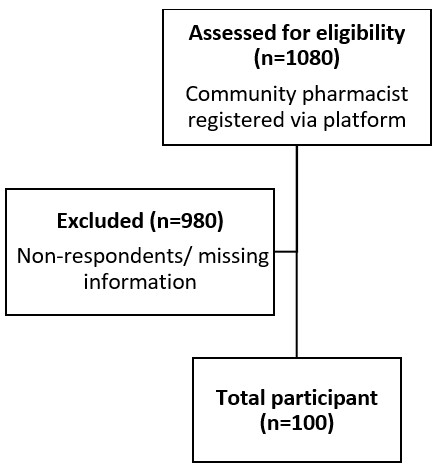
The online survey was distributed to all pharmacists (n = 1,080) registered on the continuing education platform widely used by community pharmacists in Türkiye at the time of the study via e-mail. This online continuing education platform regularly provides pharmacy-related training, with the vast majority of its members consisting of community pharmacists. Participants who did not respond, or had missing information had exluded (n=980). A total of 100 community pharmacists (~9.3%) participated in the study, participation was entirely voluntary (Figure 1).
Statistical analyses were conducted utilizing SPSS version 27.0 (IBM Corp., Armonk, NY). The Kolmogorov-Smirnov test was employed to evaluate the normality of continuous variables, revealing a significant deviation from normal distribution (p < 0.05). Consequently, nonparametric tests were employed for comparisons. The Mann-Whitney U test was utilized for comparisons between two independent groups, while the Kruskal-Wallis test was employed for comparisons involving multiple groups. A p-value below 0.05 was deemed statistically significant.
Results
A total of 100 community pharmacists participated in the study. The median age was 36.5 years (min-max: 24-65), and 22% of pharmacists had a postgraduate degree (Table 1). Participants’ pharmacy locations varied, with 44.0% working in local pharmacies, 30.0% in downtown settings, and 26.0% close to hospital pharmacies. However, neither knowledge scores nor survey responses showed a statistically significant difference based on pharmacy location.
| Table 1. Demographic Characteristics of Pharmacists | ||
| Category |
|
|
| Gender | ||
| Female |
|
|
| Male |
|
|
| Education status | ||
| Undergraduate |
|
|
| Postgraduate |
|
|
| Location of the pharmacy | ||
|
Local pharmacy (Far from city center) |
|
|
|
Downtown pharmacy (Located in the city center, shopping mall, or street) |
|
|
| Nearby a hospital |
|
|
|
|
|
|
| Age (years) |
|
|
| Professional experience (years) |
|
|
While 78% (n=78) of pharmacists indicated that they had not received any education on ONSs previously, only 17% (n=17) reported they had sufficient knowledge about ONSs. Almost half of the pharmacists (53%) conveyed storing ONSs in a proper area (avoid direct sunlight, humidity, etc.). Forty-three percent of the pharmacists reported that they were storing ONS in the area left by the person who transported it from the warehouse. In other words, they stated that they did not determine a specific area.
As for ONS prescriptions, the participant pharmacists most frequently provided information to patients or caregivers regarding usage (85%), storage conditions (65%), and prescription details (52%). A majority of pharmacists (n=67,67%) reported being unaware of the disposal method for expired ONSs. It was found that the most frequently consulted sources of information about ONS storage conditions were drug databases (n=86,86%) and product labels/packaging (n=69,69%). Furthermore, the majority of pharmacists (n=94,94%) expressed an interest in receiving education on the use of ONSs. Specifically, they indicated a need for education on general information about ONSs (89%), their use in different disease stages (84%), and their storage conditions (58%). The responses provided by pharmacists regarding ONSs are shown in Table 2.
| Table 2. Pharmacists’ responses to questions regarding ONSs | ||
| Questions |
|
|
| Have you received any education on ONSs previously? | ||
| Yes |
|
|
| No |
|
|
| Do you think that you have adequate information on ONSs? | ||
| Yes |
|
|
| Partially |
|
|
| No |
|
|
| Do you have anyone around you who uses ONS? | ||
| Yes |
|
|
| No |
|
|
| How often do you dispense ONSs at your pharmacy? | ||
| Always |
|
|
| Frequently |
|
|
| Sometimes |
|
|
| Rarely |
|
|
| Never |
|
|
| Where do you store ONS products until you dispense them to the patients? | ||
| I store them in a proper area. |
|
|
| I don’t determine in a specific area. |
|
|
| ONS products are not sold or dispensed |
|
|
| Which information do you provide to patients and caregivers about ONSs? | ||
| Usage |
|
|
| Side effect |
|
|
| Storage conditions |
|
|
| Expiration date |
|
|
| Payment terms |
|
|
| Prescription information |
|
|
| I do not provide any information |
|
|
| Which procedure do you use for the disposal of expired ONSs? | ||
|
Responses categorized as not disposed properly Throwing it the trash Pouring it into toilet/sink Asking patients to dispose on their own |
|
|
|
Responses categorized as disposed properly Delivering it to the company Delivering it to the warehouse |
|
|
| I don't know/I haven't met. |
|
|
| Do you get feedback from patients about the use of ONS? Do you follow these patients? | ||
| Yes |
|
|
| No |
|
|
| Which sources do you use to find information about the storage conditions of ONS products? | ||
| Product label/packaging |
|
|
| Drug databases |
|
|
| Guidelines |
|
|
| Seminars |
|
|
| Internet resources |
|
|
| Would you like to take a course on ONS? | ||
| Yes |
|
|
| No |
|
|
| What subjects would you like to learn from a course specifically on ONSs? | ||
| General information |
|
|
| New ONS product |
|
|
| ONS use in different diseases |
|
|
| Storage conditions of ONS products |
|
|
| Other |
|
|
Regarding the sources used by pharmacists to obtain information about ONS storage conditions, the findings revealed that the majority of participants relied primarily on drug databases (86.0%) and product labels and package inserts (69.0%), while the use of evidence-based resources such as clinical guidelines was notably limited (16.0%). Internet resources were used by only 26.0% of participants, and seminars or professional training events were reported as an information source by merely 9.0% of respondents.
Most participants demonstrated awareness of appropriate storage requirements for unopened products, such as keeping them in a cool and dark environment (83%), away from heat and humidity (83%) and sunlight (79%), and ensuring that the cap is tightly closed (70%). In addition, 76% provided the correct answer for the recommended storage temperature for unopened ONSs. In contrast, only 54% and 31% of pharmacists accurately responded to the storage duration of opened products in a refrigerator or at room temperature, respectively, while knowledge regarding powdered ONS products was lower, with only 37% providing the correct response. Regarding ONS usage, correct responses were highest for not consuming the product when it is too hot (80%) or too cold (55%), not mixing it with food or medications (77%), and not diluting it (46%).
A knowledge score was calculated for each participant based on their correct responses to 12 questions assessing ONS-related knowledge. One point was awarded for each correct answer, the total score reflecting overall knowledge. Among the pharmacists, the median knowledge score was 8.0 (IQR:3.0). The knowledge score comprised a total of 12 questions: 5 questions on unopened ONSs (score range:1–5) and 7 questions on opened ONSs (score range:1–7). Despite this difference, independent analysis of the two groups demonstrated equal median and interquartile range (IQR) values [4.0 (IQR: 2.0)].
The difference in knowledge scores between the participant pharmacists with and without an educational background on ONSs was evaluated using the Mann-Whitney U test. The analysis revealed a statistically significant difference between the two groups (p=0.005), with higher median knowledge scores [Median (IQR):9.0(3.25)] for those who received ONS’s education when compared to the other group [Median (IQR):8.0(3.0)].
A significant difference in knowledge scores regarding opened ONSs was observed between these two groups (p=0.001, Mann–Whitney U Test). Those with an educational background demonstrated higher median knowledge scores [Median (IQR):5.0(2.0)] compared to those who were not educated on ONSs [Median (IQR):4.0(1.0)], indicating that education was associated with better knowledge on handling opened ONSs.
Additionally, disparities in knowledge scores among the participant pharmacists who fully believed, partially believed, or did not believe they had sufficient knowledge about ONSs were evaluated using the Kruskal–Wallis test. A significant difference was observed (H=8.45, df=2, p=0.015), with median knowledge scores (IQR) of 9.0(3.5) for those who fully believed, 8.0(2.75) for those who partially believed, and 6.0 (5.0) for those who did not believe they had sufficient knowledge. Furthermore, a statistically significant difference was also found in knowledge scores regarding opened ONSs among these groups (H=12.43, df=2, p=0.02), indicating that pharmacists’ self-perceived knowledge was associated with their actual knowledge.
Discussion
This study’s findings indicate an important gap between the expanding clinical role of pharmacists in malnutrition management and their educational background. While the majority of participants indicated a defiency in confidence and knowledge concerning ONSs, this deficiency is not merely an individual practice gap but a systemic reflection of pharmacy curricula. Our findings correspond with prior research suggesting that healthcare professionals generally lack adequate training on nutritional products.12,13 Nonetheless, differentiating from previous literature, our data indicates that this knowledge deficit specifically stems from the insufficient coverage of clinical nutrition and products storage conditions in undergraduate programs. A qualitative study in Portugal revealed that although all community pharmacists reported that they counsel their patients on daily intake and timing of administration, only half provided guidance on storage precautions of ONSs.12 Consistently, although most pharmacists in this study reported to have provided instructions on ONS usage, fewer offered information regarding proper storage conditions, highlighting a persistent gap between pharmacy education and practice.
In chronic disease management, consistent monitoring and follow-up are essential for the assessment of the effectiveness and safety of pharmacotherapy and patients’ adherence to treatment. The literature indicates that regular communication between pharmacists and patients along with active follow-up facilitates the identification and resolution of medication-related problems, strengthens the patient–pharmacist relationship, and enhances treatment adherence.14 In this study, only about half of the pharmacists reported routine follow-ups with patients using ONSs, indicating that pharmacist-patient communication remains limited in the process of using nutritional products. Given the long-term and regular use required for ONSs, a systematic follow-up by pharmacists is crucial. Such a follow-up ensures accurate product use, allows assessment of the effectiveness of different ONS products for each patient separately, and enables pharmacists to provide tailored recommendations based on their clinical experience in addition to the information provided by manufacturers. Implementing structured follow-up mechanisms is likely to enhance both patient outcomes and overall efficacy of nutritional interventions.7,12
According to the findings of this study, 43% of pharmacists stated that they do not provide a proper area for storage of ONSs. The information given to patients or caregivers varies, just like the responses to questions regarding storage conditions. These discrepancies in knowledge and practice highlight the critical need for specialized education on ONS storage for pharmacists.7,12 In addition, 67% of pharmacists reported that they lack information on the proper disposal of expired ONSs, indicating a need for guidance on correct recycling and waste management practices. Given the multiple sources of ONS wastage, pharmacists also play a role in educating patients about proper disposal.7
The participating pharmacists demonstrated higher accuracy in responding to inquiries about the storage of unopened ONSs relative to opened products, indicating greater familiarity with pharmacy-related storage practices. The lack of knowledge regarding the handling and use of opened ONS products observed in our study is particularly concerning from a clinical safety perspective. Once a nutritional product package is opened, contamination may occur through air flow, fluid drip, or consumer handling, which may introduce new pathogens or accelerate microbial growth.15 Comprehensive guidance on appropriate storage throughout the duration of ONS use is, thus, essential to support patient adherence.6,10
In clinical practice, some issues in ONS prescribing may arise, potentially including treatment effectiveness and patient adherence.3 Pharmacists play a central role in addressing these challenges by facilitating communication between patients and physicians, identifying inappropriate use, and promoting adherence. A lack of sufficient expertise or confidence among pharmacists and other healthcare professionals in diagnosing malnutrition and counseling patients effectively can negatively impact treatment outcomes and adherence, underscoring the important role of pharmacists in managing ONS therapy.9
Regarding the sources used by pharmacists to obtain information about ONS storage conditions, the majority of participants relied primarily on drug databases and product labels, while clinical guidelines and peer-reviewed literature were rarely consulted. Notably, seminars were among the least frequently reported sources, likely reflecting the scarcity of structured continuing education programs on ONS-related topics. These findings highlight a critical gap in both information-seeking behavior and the availability of targeted professional development initiatives for community pharmacists.
Undergraduate pharmacy curricula often lack nutrition education, which is offered only through elective courses/extended programs at a limited number of universities.16 This global gap in nutrition education affects pharmacy, medical, and nursing programs.17 Undergraduate nutrition education can be advantageous for students who want to work in healthcare professions.
In our study, although pharmacists with postgraduate degrees showed a numerical trend towards higher knowledge scores, the lack of statistical significance suggests that even advanced degrees may not sufficiently cover specific ONS competencies unless focused specifically on clinical nutrition. This underscores a broader need: nutrition education must be integrated not just as theoretical knowledge but as a practical, competency-based component of the core pharmacy curriculum.
To address the identified gaps, particularly in product storage conditions and patient follow-up, pharmacy educators should consider adopting active learning strategies. ONS management should be prioritized in Continuing Professional Development programs to support the current workforce.
This study has several limitations that should be acknowledged. The relatively small sample size and the low response rate limit the generalizability of the results to the broader community pharmacist population in Turkey. This limited response may be due to variations in pharmacists’ familiarity and interest, as some community pharmacists still do not have a thorough understanding of ONS. Consequently, future studies with larger and more geographically diverse samples are warranted to confirm and extend these findings.
Despite these limitations, the study offers valuable insights into pharmacists’ current knowledge and practices regarding ONSs, and it provides a baseline for future research to assess the effects of targeted training and follow-up strategies.
This study highlights significant gaps in pharmacists’ education and knowledge regarding ONSs, particularly concerning the storage and use of opened products compared to unopened ones. The participants’ strong interest in further training—particularly on disease-specific use and storage conditions—reflects a high awareness of these deficiencies and a willingness to enhance patient care. Integrating nutrition education into pharmacy curricula may address current knowledge gaps and enable pharmacists to implement better interventions and counselling in order to optimize patient outcomes, adherence to ONS therapy, and the overall effectiveness of nutritional treatment.
Ethical approval
This study was approved by the Hacettepe University Research Ethics Committee for Health Sciences (Date: 27.11.2024, Decision/Protocol No: SBA 24/1180). Informed consent was obtained from all participants involved in this study.
Data availability statement
The data supporting the findings of this study are not publicly available due to .
Conflict of interest
The authors declare that this study was conducted in the absence of any commercial or financial relationships that could be construed as a potential conflict of interest.
Funding
The authors declare that this study received no funding.
Generative AI statement
The authors declare that no generative AI or AI-assisted technologies were used in the writing or preparation of this study.
References
- Saunders J, Smith T. Malnutrition: causes and consequences. Clin Med (Lond). 2010;10(6):624-627. https://doi.org/10.7861/clinmedicine.10-6-624
- Medical Nutrition International Industry. Oral nutritional supplements to tackle malnutrition: a summary of the evidence base. 2023. Available at: https://www.medicalnutritionindustry.org/content/uploads/2023/10/mnibookletfinal2911-3.pdf (Accessed on September 20, 2025).
- Dent E, Wright ORL, Woo J, Hoogendijk EO. Malnutrition in older adults. Lancet. 2023;401(10380):951-966. https://doi.org/10.1016/S0140-6736(22)02612-5
- Arends J, Bachmann P, Baracos V, et al. ESPEN guidelines on nutrition in cancer patients. Clin Nutr. 2017;36(1):11-48. https://doi.org/10.1016/j.clnu.2016.07.015
- Kaufman-Shriqui V, Salem H, Birk R, Boaz M. Nutrition knowledge translation performance in health professionals: findings from the 2017 Unified Forces Preventive Nutrition Conference (UFPN). Nutrients. 2019;11(2):390. https://doi.org/10.3390/nu11020390
- Hubbard GP, Elia M, Holdoway A, Stratton RJ. A systematic review of compliance to oral nutritional supplements. Clin Nutr. 2012;31(3):293-312. https://doi.org/10.1016/j.clnu.2011.11.020
- Browne S, Kelly L, Geraghty AA, et al. Healthcare professionals’ perceptions of malnutrition management and oral nutritional supplement prescribing in the community: a qualitative study. Clin Nutr ESPEN. 2021;44:415-423. https://doi.org/10.1016/j.clnesp.2021.04.024
- Dominguez Castro P, Reynolds CM, Kennelly S, et al. General practitioners’ views on malnutrition management and oral nutritional supplementation prescription in the community: a qualitative study. Clin Nutr ESPEN. 2020;36:116-127. https://doi.org/10.1016/j.clnesp.2020.01.006
- Geraghty AA, Browne S, Reynolds CME, et al. Malnutrition: A misunderstood diagnosis by primary care health care professionals and community-dwelling older adults in Ireland. J Acad Nutr Diet. 2021;121(12):2443-2453. https://doi.org/10.1016/j.jand.2021.05.021
- Bahat G, Akmansu M, Güngör L, et al. Beslenme destek tedavisinde oral nütrisyonel destek ürünleri kullanimı: KEPAN rehberi. Clinical Science of Nutrition. 2022;4:1-35. https://doi.org/10.5152/ClinSciNutr.2022.120122
- Yıldız Ilıman A, Yurttaş M, Ergül DF. Enteral beslenme ürünlerinde kontaminasyon düzeylerinin incelenmesi: yoğun bakım örneği. Gümüşhane Üniversitesi Sağlık Bilimleri Dergisi. 2024;13(1):158-164. https://doi.org/10.37989/gumussagbil.1320458
- Gregório J, Tavares P, Alves E. Pharmacists’ perceptions on nutritional counseling of oral nutritional supplements in the community pharmacy: an exploratory qualitative study. Pharmacy (Basel). 2023;11(2):78. https://doi.org/10.3390/pharmacy11020078
- Gürlek Kısacık Ö, Çoşğun T. Hemşirelerde nütrisyonel değerlendirmeye ilişkin tutumun, nütrisyonel bakıma ilişkin bilgi düzeyi ve algılanan bakım kalitesinin belirlenmesi. Celal Bayar Üniversitesi Sağlık Bilimleri Enstitüsü Dergisi. June 2021;8(2):204-217. https://doi.org/10.34087/cbusbed.767803
- MacCallum L, Dolovich L. Follow-up in community pharmacy should be routine, not extraordinary. Can Pharm J (Ott). 2018;151(2):79-81. https://doi.org/10.1177/1715163518756586
- EFSA Panel on Biological Hazards (BIOHAZ) , Koutsoumanis K, Allende A, et al. Guidance on date marking and related food information: part 2 (food information). EFSA J. 2021;19(4):e06510. https://doi.org/10.2903/j.efsa.2021.6510
- Medical Nutrition International Industry. Oral nutritional supplements to tackle malnutrition: a summary of the evidence base. 2023. Available at: https://www.medicalnutritionindustry.org/content/uploads/2023/10/mnibookletfinal2911-3.pdf (Accessed on September 20, 2025).
- Mogre V, Stevens FCJ, Aryee PA, Amalba A, Scherpbier AJJA. Why nutrition education is inadequate in the medical curriculum: a qualitative study of students’ perspectives on barriers and strategies. BMC Med Educ. 2018;18(1):26. https://doi.org/10.1186/s12909-018-1130-5
Copyright and license
Copyright © 2026 The author(s). This is an open-access article under the terms of the Creative Commons Attribution License (CC BY) which permits unrestricted use, distribution, and reproduction in any medium or format, provided the original work is properly cited.