

Abstract
Objective: To investigate the associations of Mediterranean diet adherence and serum zonulin concentrations with assisted reproductive treatment outcomes, and to exploratorily compare women who self-selected Mediterranean diet counseling with those continuing their usual diet over 12 weeks.
Methods: This prospective observational pilot study included 123 women starting infertility treatment at a private IVF center between February and July 2024. Women who chose individualized Mediterranean diet counseling formed the counseling-exposed group (n=42), while those continuing their usual diet formed the comparison group (n=81). MEDAS scores and serum zonulin concentrations were assessed at baseline and week 12. Clinical pregnancy was evaluated among women who underwent embryo transfer.
Results: Among 123 women, 42 were in the counseling-exposed group and 81 in the comparison group. Embryo-transfer analyses included 58 women, 33 in the counseling-exposed group and 25 in the comparison group. Clinical pregnancy occurred in 22/33 and 5/25 women, respectively. At week 12, MEDAS scores were higher in the counseling-exposed group than in the comparison group (9.5 ± 1.16 vs. 6.3 ± 1.25, p=0.021). Among women who underwent embryo transfer, follow-up zonulin concentrations were lower in those with clinical pregnancy than in those without clinical pregnancy in both the counseling-exposed group (2.8 ± 0.6 vs. 3.3 ± 0.3, p=0.036) and the comparison group (6.6 ± 0.8 vs. 10.7 ± 13.1, p=0.027). In exploratory multivariable analysis, lower follow-up zonulin (OR=0.52, 95% CI: 0.34–0.82, p=0.014) and lower follow-up BMI (OR=0.94, 95% CI: 0.91–0.97, p=0.002) were associated with clinical pregnancy. Follow-up MEDAS showed a positive but non-significant association (OR=1.35, 95% CI: 0.97–1.89, p=0.078).
Conclusion: In this prospective observational pilot study, clinical pregnancy was associated with lower follow-up serum zonulin concentrations, while higher Mediterranean diet adherence showed a non-significant favorable trend. These exploratory findings require confirmation in larger studies with stronger control of confounding.
Keywords: infertility, intestinal barrier function, Mediterranean diet, zonulin
Main Points
- Women who received Mediterranean diet counseling had higher adherence scores at 12 weeks.
- Higher Mediterranean diet adherence correlated with lower serum zonulin at baseline and at 12 weeks.
- Lower follow-up zonulin and BMI were linked to clinical pregnancy after embryo transfer in adjusted analyses.
- Week-12 diet adherence was not significantly linked to clinical pregnancy after adjustment.
Introduction
Infertility is generally defined as the inability to achieve a clinical pregnancy after 12 months of regular unprotected intercourse, or after 6 months in women older than 35 years, and it remains an important reproductive and public health concern worldwide.1 In most couples, infertility can be attributed to identifiable factors such as ovulatory dysfunction, male-factor infertility, or tubal disease; however, a considerable proportion of cases remain unexplained.1,2 Given the multifactorial nature of infertility, increasing attention has been directed toward modifiable preconception factors, particularly dietary and lifestyle patterns that may influence reproductive function.3,4
The Mediterranean diet, characterized by a high intake of vegetables, fruits, legumes, nuts, whole grains, and olive oil, along with moderate consumption of fish and dairy products and low consumption of red and processed meat, has been widely associated with favorable cardiometabolic and anti-inflammatory effects.5,6 In the context of reproductive health, growing evidence suggests that greater adherence to Mediterranean-style dietary patterns may be associated with improved fertility-related parameters and assisted reproduction outcomes.7-11 These associations may be mediated, at least in part, through effects on inflammation, oxidative balance, and metabolic regulation, which are increasingly recognized as important contributors to female reproductive function.3,10,12
Another biologically plausible pathway linking diet and reproductive health is intestinal barrier integrity. The intestinal barrier is maintained by the epithelial layer and intercellular tight junctions, which regulate permeability and restrict the translocation of luminal antigens, endotoxins, and microbial products into the systemic circulation.13 Disruption of this barrier has been implicated in chronic low-grade inflammation, gut dysbiosis, and a range of metabolic and inflammatory disorders.14,15 Zonulin, a physiological modulator of tight junction function, is frequently used as a circulating marker related to intestinal permeability, although its interpretation should be made cautiously.16-18 Emerging evidence further suggests that elevated zonulin concentrations may also be associated with reproductive disorders and impaired ovarian function.19
Although the Mediterranean diet has been linked to changes in the gut microbiota and inflammatory milieu, evidence directly examining its relationship with serum zonulin concentrations in infertile women remains limited. In addition, data on zonulin in infertility populations are still scarce.
Therefore, the primary aim of this prospective observational pilot study was to investigate the associations between Mediterranean diet adherence, serum zonulin concentrations, and ART-related outcomes in women initiating infertility treatment. A secondary exploratory aim was to compare changes in Mediterranean diet adherence and serum zonulin concentrations between women who self-selected individualized Mediterranean diet counseling and those who continued their usual diet. Because group allocation was based on participant preference rather than randomization, the counseling-related comparisons were interpreted as exploratory and not as evidence of causal intervention effects.
Materials and methods
This prospective observational pilot study was conducted between February and July 2024 at a private in vitro fertilization (IVF) center. Women aged 20–45 years with a body mass index (BMI) of 18.5-29.9 kg/m2 who were scheduled to start infertility treatment and who voluntarily agreed to participate were eligible. Physical activity was assessed using the International Physical Activity Questionnaire (IPAQ), and women with moderate physical activity levels were included. Because this was a pilot study, the sample size was determined by feasibility and recruitment during the study period rather than by a formal power calculation.
The study was approved by the Başkent University Medical and Health Sciences Research Board on 27 December 2023 (Approval No. KA23/386) and was conducted in accordance with the Declaration of Helsinki. Written informed consent was obtained from all participants prior to inclusion. The study was registered at ClinicalTrials.gov (NCT07072936; registered on 20 January 2025). Registration was retrospective and did not alter the study protocol, data collection procedures, or primary analyses.
Study design: This study is a prospective observational pilot study investigating the relationships between adherence to the Mediterranean diet, serum zonulin levels, and ART outcomes in women initiating infertility treatment. Comparisons between the group receiving dietary counseling and the group maintaining their usual diet are exploratory in nature. Participants were classified according to whether they chose to receive Mediterranean diet counseling at baseline. Women who accepted counseling and an individualized diet plan comprised the counseling-exposed group, whereas women who did not receive counseling and continued their usual diet comprised the comparison group. Thus, group membership was self-selected rather than randomized, and the study should be interpreted as observational. Eligibility was restricted to women with low-to-moderate baseline Mediterranean diet adherence (MEDAS ≤8) to reduce heterogeneity at study entry.
The comparison group was included to provide an observational reference for changes occurring over the same 12-week period among women who did not receive structured Mediterranean diet counseling. However, because participants self-selected their exposure status, this group was not considered a randomized control group. Therefore, between-group comparisons were used to describe exploratory differences rather than to estimate the causal effect of counseling.
Outcomes and variables: The primary clinical outcome was clinical pregnancy, recorded by the IVF center. Clinical pregnancy was defined as ultrasonographic confirmation of an intrauterine gestational sac with fetal cardiac activity. Women who did not proceed to embryo transfer were excluded from analyses focused on pregnancy outcomes, and these subgroup analyses are reported separately. Secondary outcomes were change in serum zonulin and change in Mediterranean diet adherence (MEDAS) over 12 weeks. Main exposure and covariate variables included group membership, MEDAS, BMI, physical activity, caffeine intake, and selected baseline sociodemographic and infertility characteristics.
Data collection: A structured questionnaire was administered during face-to-face interviews to collect sociodemographic data (e.g., age, education, occupation), medical history, infertility history (duration and etiology), prior infertility treatments, dietary habits (meal patterns and reasons for skipping meals), and caffeine consumption.
Follow-up timeline: The dietary counseling exposure and follow-up period lasted 12 weeks, a duration comparable to prior nutrition studies evaluating zonulin. The study procedures and follow-up schedule are summarized in Figure 1.
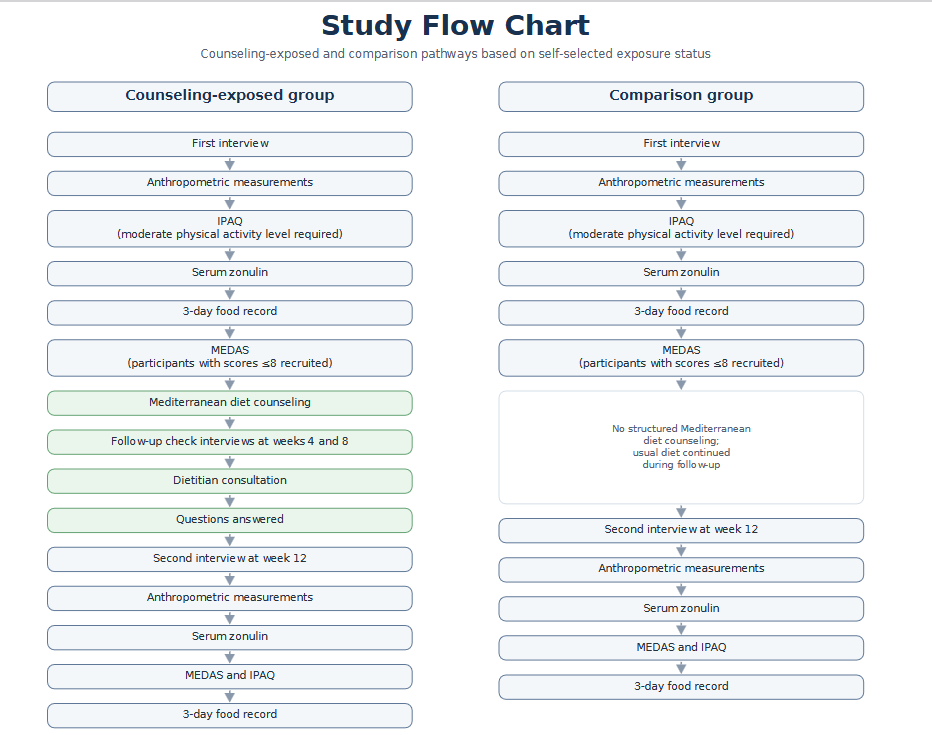
Mediterranean diet counseling: Women in the counseling-exposed group received an individualized nutrition plan compatible with the Mediterranean diet according to estimated daily energy requirements (Schofield equation and physical activity from IPAQ), without intentional energy restriction. Mediterranean diet education was provided at baseline, and participants were contacted at weeks 4 and 8 to address questions and reinforce counseling. Three-day food consumption records (two weekdays and one weekend day) were collected at baseline and at week 12. Women in the comparison group continued their usual diet during the 12-week follow-up.
Mediterranean diet adherence: Mediterranean diet adherence was assessed at baseline and week 12 using the 14-item Mediterranean Diet Adherence Screener (MEDAS), originally developed in the context of the PREDIMED study to rapidly evaluate adherence to key components of the Mediterranean dietary pattern. The Turkish validity and reliability of MEDAS has been reported by Bekar and Goktas.20 The scale evaluates dietary components such as olive oil, vegetables, fruits, legumes, nuts, fish, meat, and wine. Each item is scored as 0 or 1, yielding a total score ranging from 0 to 14, with higher scores indicating greater adherence. Scores are commonly categorized as ≤5 for low adherence, 6–8 for moderate adherence, and ≥9 for high adherence. Women with low or moderate baseline adherence (MEDAS ≤8) were eligible for inclusion.
Serum zonulin measurement: Serum samples were collected at baseline and at week 12, aliquoted, and stored at −80°C until analysis. Each sample underwent a single freeze–thaw cycle prior to measurement. Serum zonulin concentrations were measured using the IDK® Zonulin ELISA (Immundiagnostik AG; Cat. No. K 5601) according to the manufacturer’s instructions. According to the kit insert, serum samples are stable for 1 day at 4°C, 4 weeks at −20°C, and for longer storage at −80°C.21
To reduce potential selection and information bias, all participants were recruited from the same center, assessed with the same baseline and 12-week procedures, and evaluated using the same laboratory and questionnaire methods. Restriction of eligibility criteria (including BMI range, activity level, and baseline MEDAS ≤8) was used to reduce heterogeneity at entry. Pregnancy-outcome analyses were restricted to women who underwent embryo transfer by design. This manuscript was prepared with consideration of the STROBE reporting guideline for observational studies.22
Baseline dietary assessment and blood sampling were performed before or at the initiation of infertility treatment. The 12-week follow-up assessment, including MEDAS and serum zonulin measurement, was performed before embryo transfer. Embryo transfer was performed according to the clinical treatment schedule of the IVF center. Controlled ovarian stimulation was initiated on cycle day 2 or 3 using clomiphene citrate, letrozole, recombinant FSH, and/or hMG, with medication type and dose individualized according to AMH, FSH, age, and other patient-specific characteristics. In fresh embryo transfer cycles, a GnRH antagonist was added when the leading follicle exceeded 14 mm, whereas progesterone suppression was used in frozen embryo transfer protocols. Final oocyte maturation was triggered with either 0.5 mg GnRH agonist or 10,000 IU hCG, and oocyte retrieval was performed approximately 34–35 hours later. The outcome of the first embryo transfer cycle after oocyte retrieval was evaluated. Clinical pregnancy was assessed by ultrasonographic confirmation of an intrauterine gestational sac with fetal cardiac activity at 3–4 weeks after embryo transfer. Therefore, follow-up zonulin concentrations were interpreted as pre-transfer exposure biomarkers depending on the timing of assessment.
Caffeine intake: Caffeine was included as an exploratory covariate because consumption level may reflect lifestyle patterns relevant to reproductive outcomes and may also be associated with dietary quality and gastrointestinal physiology. It was assessed using a caffeine consumption frequency record form developed by Otman in 2017 and previously used in a master’s thesis study .23
Although recommendations vary, ACOG and EFSA advise limiting caffeine intake during pregnancy to below 200 mg/day, while WHO recommends a limit of below 300 mg/day.24,25 However, there is no clear consensus regarding caffeine safety during the preconception period.
IPAQ
Participants’ physical activity levels were assessed using the Turkish valid and reliable version of International Physical Activity Questionnaire–Short Form (IPAQ-SF).26 The duration and frequency of walking, moderate-intensity, and vigorous-intensity physical activities performed during the last seven days were recorded, and total physical activity level was calculated as MET-minutes/week.
Statistical analysis
Analyses were conducted using SPSS 22.0. Categorical variables are presented as n (%). Continuous variables are presented as mean ± SD for approximately normally distributed data and as median (IQR) for non-normally distributed data. Normality was assessed using the Shapiro-Wilk test and by visual inspection of histograms and Q-Q plots. Correlations were assessed using Spearman’s rho. For between-group comparisons, the independent-samples t-test was used for normally distributed variables and the Mann-Whitney U test for non-normally distributed variables. Within-group changes were evaluated using paired-samples t-tests or Wilcoxon signed-rank tests, as appropriate. For comparisons across three or more independent groups, one-way ANOVA was used for normally distributed variables and the Kruskal-Wallis test for non-normally distributed variables. Post-hoc pairwise comparisons were performed using Tukey HSD following ANOVA or appropriate non-parametric post-hoc procedures after Kruskal-Wallis testing. Exploratory logistic regression analyses among women who underwent embryo transfer included follow-up zonulin, follow-up MEDAS, follow-up BMI, age, physical activity, and caffeine intake as covariates selected on clinical relevance and data availability. Continuous variables were analysed on their original scales, while MEDAS categories were used descriptively. The number of participants included in each analysis is shown in the text and tables. No imputation was performed for missing data, and no formal sensitivity analyses were undertaken. Statistical significance was set at p < 0.05 (two-sided).
Results
In the main cohort, 42 women were included in the counseling-exposed group and 81 in the comparison group. Among women who underwent embryo transfer, 33 were in the counseling-exposed group and 25 were in the comparison group. Clinical pregnancy was observed in 22/33 women in the counseling-exposed group and 5/25 women in the comparison group. Mean age did not differ significantly between groups (32.3 ± 6.78 vs. 33.2 ± 5.67 years; p>0.05). Baseline anthropometric characteristics and physical activity levels were generally comparable between the counseling-exposed and comparison groups, including body weight (66.2 ± 9.07 vs. 68.3 ± 9.04 kg, p=0.466), BMI (24.9 ± 3.12 vs. 25.2 ± 3.15 kg/m2, p=0.189), and IPAQ score (919.2 ± 517.2 vs. 808.0 ± 243.2 MET-min/week, p=0.620). Baseline MEDAS scores were also similar between groups (5.8 ± 2.16 vs. 5.9 ± 1.23, p=0.742). At week 12, the counseling-exposed group had significantly lower body weight (64.4 ± 8.77 vs. 69.7 ± 7.85 kg, p=0.036) and BMI (23.8 ± 2.54 vs. 25.4 ± 2.69 kg/m2, p=0.013), as well as higher MEDAS scores (9.5 ± 1.16 vs. 6.3 ± 1.25, p=0.021), compared with the comparison group. Changes over 12 weeks also favored the counseling-exposed group, with greater reductions in body weight (−1.83 ± 1.36 vs. +1.42 ± 1.25 kg, p=0.021) and BMI (−1.12 ± 0.49 vs. +0.24 ± 0.47 kg/m2, p=0.036), and a greater increase in MEDAS score (+3.7 ± 2.39 vs. +0.4 ± 1.89, p=0.001) (Table 1).
| Table 1. Anthropometric measurements and scale results of women. | |||
|
|
|
|
|
|
|
|
||
| Height, cm |
|
|
|
| Basal metabolic rate, kcal |
|
|
|
| Body weight, beginning, kg |
|
|
|
| Body weight, 12 weeks later, kg |
|
|
|
| Body weight Δ, kg |
|
|
|
| BMI, beginning, kg/ m2 |
|
|
|
| BMI, 12 weeks later, kg/ m2 |
|
|
|
| BMI Δ, kg/ m2 |
|
|
|
| Waist circumference, cm |
|
|
|
| Hip circumference, cm |
|
|
|
| Waist / Hip, cm |
|
|
|
| Waist / Height, cm |
|
|
|
| MEDAS, baseline |
|
|
|
| MEDAS, 12 weeks later |
|
|
|
| MEDAS Δ |
|
|
|
| IPAQ |
|
|
|
| BMI, body mass index; IPAQ, International Physical Activity Questionnaire; MEDAS, Mediterranean Diet Adherence Screener. Statistical tests as in the original table notes; significance set at p<0.05. | |||
In the counseling-exposed group, changes in MEDAS scores differed by embryo transfer status (Table 2). Women who later underwent embryo transfer showed a greater increase in MEDAS. Pregnancy-outcome subgroup analysis (embryo transfer only) is presented in Table 3. In both groups, women with a clinical pregnancy tended to have lower follow-up zonulin concentrations and larger decreases in zonulin (Δ) compared with women without a clinical pregnancy.
| T1: baseline (onset of the study). T2: week 12 (end of the study). Statistical tests and p-values as indicated in the table; significance set at p<0.05. p1: Differences between MEDAS scores in women with and without embryo transfer. p2: Between-group difference in the change in MEDAS scores according to embryo transfer status. | ||||||
| Table 2. Mean Mediterranean diet adherence screener (MEDAS) scores of women in the counseling group according to embryo transfer status. | ||||||
| Counseling Group |
|
|
|
|
||
|
|
|
|
|
|||
| MEDAS, T1 |
|
|
|
|
|
|
| MEDAS, T2 |
|
|
|
|
|
|
| MEDAS Δ |
|
|
|
|
|
|
| T1: baseline (onset of the study). T2: week 12 (end of the study); significance set at p<0.05. p1: Difference between women with positive versus negative pregnancy outcomes in the counseling group, p2: Difference between women with positive versus negative pregnancy outcomes in the comparison group, p3: Difference between the counseling and comparison groups among women with clinical pregnancy, p4: Difference between the counseling and comparison groups among women with negative clinical pregnancy. | ||||||||
| Table 3. Clinical pregnancy outcome parameters among women who underwent embryo transfer. | ||||||||
|
|
|
|
|
|
|
|||
|
|
|
|
|
|||||
| Zonulin, T1 |
|
|
|
|
|
|
|
|
| Zonulin, T2 |
|
|
|
|
|
|
|
|
| Zonulin Δ |
|
|
|
|
|
|
|
|
| MET-min/week |
|
|
|
|
|
|
|
|
| Caffeine (mg/day) |
|
|
|
|
|
|
|
|
| Cigarette (n/day) |
|
|
|
|
|
|
|
|
| BMI (kg/m2), T1 |
|
|
|
|
|
|
|
|
| BMI (kg/m2), T2 |
|
|
|
|
|
|
|
|
Baseline MEDAS score was significantly and inversely correlated with baseline serum zonulin concentration according to Spearman’s correlation analysis (rho = −0.545, p = 0.005). A similar significant inverse correlation was observed between week-12 MEDAS score and week-12 serum zonulin concentration (rho = −0.450, p = 0.042).
In the exploratory multivariable model, clinical pregnancy was significantly associated with lower follow-up zonulin and lower follow-up BMI. Follow-up MEDAS score and caffeine intake were suggestive of association but did not reach conventional statistical significance, whereas age and physical activity were not associated with the outcome (Table 4). These adjusted findings should be considered preliminary given the pilot design, the observational group classification, and the limited sample size.
| Table 4. Exploratory multivariable model of predictors of clinical pregnancy among women who underwent embryo transfer. | |||
| Predictor |
|
|
|
| Zonulin, T2 |
|
|
|
| MEDAS, T2 |
|
|
|
| BMI (kg/m2), T2 |
|
|
|
| Age, years |
|
|
|
| MET-min/week, T2 |
|
|
|
| Caffeine, T2 |
|
|
|
| *Logistic regression analysis. The model showed acceptable goodness-of-fit according to the Hosmer–Lemeshow test (p= 0.625). | |||
Discussion
In this prospective observational pilot study, adherence to the Mediterranean diet improved over the 12-week follow-up period in the group exposed to dietary counseling. This improvement was accompanied by modest reductions in body weight and BMI, despite the absence of a prescribed energy-restricted diet. In addition, baseline Mediterranean diet adherence was inversely correlated with baseline zonulin concentrations, suggesting that better dietary quality may be associated with lower levels of markers related to intestinal permeability.
Among the women who underwent embryo transfer, follow-up zonulin concentrations were lower in those who achieved a clinical pregnancy than in those who did not. Although these findings do not allow causal inference, they raise the possibility that intestinal barrier function may be relevant to fertility treatment outcomes and may represent one of the pathways through which dietary patterns influence reproductive health.
Previous studies have suggested that Mediterranean-style dietary patterns may be associated with reproductive health and assisted reproduction outcomes, although the literature remains heterogeneous and findings appear to vary according to population characteristics, study design, and duration of exposure or intervention.7,12 In the present study, Mediterranean diet adherence increased substantially over a relatively short period. However, the association between MEDAS scores and pregnancy outcomes did not reach statistical significance, which may be related to the limited sample size and the pilot nature of the study.
Body weight and BMI are clinically important in both infertility and pregnancy. Higher BMI has been associated with longer time to pregnancy as well as adverse pregnancy-related outcomes.27,28 To reduce heterogeneity and limit potential confounding, we included only women with BMI values in the normal and overweight range (18.5-29.9 kg/m2).
In the present study, higher Mediterranean diet adherence was significantly associated with lower serum zonulin concentrations, both at baseline and after the 12-week follow-up period. Since zonulin is commonly considered an indirect marker of intestinal permeability, this inverse relationship may suggest a beneficial role of the Mediterranean dietary pattern in maintaining intestinal barrier integrity. The high content of fiber, antioxidants, polyphenols, and unsaturated fatty acids in the Mediterranean diet may contribute to this effect through modulation of gut microbiota composition, reduction of low-grade inflammation, and improvement of epithelial barrier function. These findings are in line with previous evidence suggesting that healthier dietary patterns, particularly those rich in plant-based foods and anti-inflammatory nutrients, may be associated with lower concentrations of biomarkers related to intestinal barrier dysfunction.29,30 Nevertheless, conflicting or limited findings have also been reported in the literature, possibly due to heterogeneity in participant characteristics, BMI status, reproductive or metabolic conditions, infertility etiology, baseline dietary habits, intervention length, and differences in the assessment of zonulin or intestinal permeability. Thus, while our results support a possible link between Mediterranean diet adherence and improved gut barrier-related outcomes, further controlled studies with larger samples and longer follow-up periods are needed to clarify this relationship.
Beyond gut barrier-related findings, the present results are also broadly consistent with previous studies suggesting that Mediterranean-style dietary patterns may be associated with improved reproductive and ART-related outcomes.31 However, evidence in this field remains heterogeneous, and methodological differences such as timing of dietary assessment, ART protocols, infertility characteristics, and sample size may contribute to discrepancies between studies.32 In the current study, follow-up MEDAS was not independently associated with clinical pregnancy at the conventional level of statistical significance after adjustment, suggesting that dietary adherence alone may not fully explain treatment outcomes in this pilot sample. Therefore, the observed associations should be interpreted cautiously and primarily as hypothesis-generating.
From a mechanistic perspective, adherence to the Mediterranean diet may influence intestinal permeability and systemic inflammation through several pathways, including higher intake of dietary fiber and polyphenols, improved fat quality, and modulation of the gut microbiota.33 Previous studies have also reported elevated zonulin concentrations in women with diminished ovarian reserve and in those with polycystic ovary syndrome, supporting a possible link between gut barrier dysfunction and reproductive disorders.19,33 In our study, the observed direction of the association between greater Mediterranean diet adherence and lower zonulin concentrations is in line with this proposed mechanism. Nevertheless, the change in zonulin at the group level was not statistically significant, which may reflect the short follow-up period and limited sample size.
An additional issue that should be considered when interpreting these findings is the measurement of serum zonulin itself. Although a commercially available ELISA kit was used, serum zonulin assessment has recognized analytical limitations, particularly with respect to assay specificity and the interpretation of measured concentrations. For this reason, the zonulin-related findings in the present study should be viewed as exploratory rather than as definitive evidence of intestinal barrier dysfunction. Although the observed associations may be biologically plausible, they should not be taken as support for the clinical use of zonulin as a validated biomarker in infertility treatment at this stage. Larger studies using more robust analytical methods are needed to clarify the relevance of this pathway and its possible contribution to treatment outcomes.
Limitations and future directions
This pilot study has several limitations. First, the sample size was modest (n = 123), which limited statistical power and precision. Second, because participants self-selected whether to receive dietary counseling, selection bias and residual confounding are possible despite the eligibility restrictions and exploratory adjusted analyses. Third, pregnancy outcomes were assessed only among women who proceeded to embryo transfer; therefore, these subgroup findings may not be generalizable to the entire enrolled cohort and may have been influenced by factors associated with reaching the transfer stage. Fourth, the follow-up period was relatively short (12 weeks), and dietary adherence was assessed primarily using MEDAS and 3-day food records, both of which are subject to self-report bias and measurement error. Fifth, several IVF-related parameters, including embryo quality, stimulation protocol, and the number of embryos transferred, were not standardized or fully captured, leaving room for residual confounding. Finally, serum zonulin was measured using a commercially available ELISA, and both assay-related and pre-analytical factors may have influenced the measured concentrations; accordingly, these biomarker findings should be interpreted as exploratory. Because the study was conducted at a single private IVF center and included women with a restricted BMI range and baseline MEDAS ≤8, external validity may be limited.
Conclusion
In this prospective observational pilot study, greater adherence to the Mediterranean diet tended to be associated with lower serum zonulin concentrations, and lower follow-up zonulin levels were observed among women who achieved a clinical pregnancy after embryo transfer. These exploratory findings are hypothesis-generating. Larger prospective studies with better control of confounding and more detailed reproductive endpoints are needed to clarify whether intestinal barrier-related pathways are relevant to infertility treatment success.
Ethics committee approval
The study was approved by the ethics committee. Name of the Committee: Başkent University Medical and Health Sciences Research Board; Date: December 27, 2023; Decision / Protocol Number: KA23/386.
Informed consent
Written informed consent was obtained from the patient(s) or their legal guardians for the publication of this study and any accompanying images.
Conflict of interest
The authors declare that there is no conflict of interest to disclose.
Funding
The authors declare that the study received no funding.
Data availability statement
The data that support the findings of this study are available from the corresponding author upon reasonable request.
Generative AI statement
The authors declare that no generative AI or AI-assisted technologies were used in the writing or preparation of this manuscript.
References
- Graham ME, Jelin A, Hoon AH, Wilms Floet AM, Levey E, Graham EM. Assisted reproductive technology: short- and long-term outcomes. Dev Med Child Neurol. 2023;65(1):38–49. https://doi.org/10.1111/dmcn.15332
- Carson SA, Kallen AN. Diagnosis and management of infertility: a review. JAMA. 2021;326(1):65–76. https://doi.org/10.1001/jama.2021.4788
- Wang XM, Ma ZY, Song N. Inflammatory cytokines IL-6, IL-10, IL-13, TNF-α and peritoneal fluid flora were associated with infertility in patients with endometriosis. Eur Rev Med Pharmacol Sci. 2018;22(9):2513–2518. https://doi.org/10.26355/eurrev_201805_14899
- Garruti G, Depalo R, De Angelis M. Weighing the impact of diet and lifestyle on female reproductive function. Curr Med Chem. 2019;26(19):3584–3592. https://doi.org/10.2174/0929867324666170518101008
- Trajkovska Petkoska A, Ognenoska V, Trajkovska-Broach A. Mediterranean diet: from ancient traditions to modern science-a sustainable way towards better health, wellness, longevity, and personalized nutrition. Sustainability. 2025;17(9):4187. https://doi.org/10.3390/su17094187
- Rosato V, Temple NJ, La Vecchia C, Castellan G, Tavani A, Guercio V. Mediterranean diet and cardiovascular disease: a systematic review and meta-analysis of observational studies. Eur J Nutr. 2019;58(1):173–191. https://doi.org/10.1007/s00394-017-1582-0
- Baroutis D, Kalampokas T, Katsianou E, et al. The role of the Mediterranean diet in assisted reproduction: a literature review. Nutrients. 2024;16(16):2807. https://doi.org/10.3390/nu16162807
- Martín-Manchado L, Moya-Yeste AM, Sánchez-Sansegundo M, et al. Associations of nutritional status and dietary habits with the development of female infertility. A case-control study. Front Nutr. 2024;11:1476784. https://doi.org/10.3389/fnut.2024.1476784
- Gaskins AJ, Nassan FL, Chiu YH, et al. Dietary patterns and outcomes of assisted reproduction. Am J Obstet Gynecol. 2019;220(6):567.e1-567.e18. https://doi.org/10.1016/j.ajog.2019.02.004
- Donato M, Capalbo A, Morizio E, et al. The role of lifestyle intervention in female fertility: a modifiable factor for preconception health. Nutrients. 2025;17(13):2101. https://doi.org/10.3390/nu17132101
- Zaragoza-Martí A, Ruiz-Ródenas N, Herranz-Chofre I, Sánchez-SanSegundo M, Serrano Delgado VC, Hurtado-Sánchez JA. Adherence to the Mediterranean diet in pregnancy and its benefits on maternal-fetal health: a systematic review of the literature. Front Nutr. 2022;9:813942. https://doi.org/10.3389/fnut.2022.813942
- Lin YH, Chen YH, Chang HY, Au HK, Tzeng CR, Huang YH. Chronic niche inflammation in endometriosis-associated infertility: current understanding and future therapeutic strategies. Int J Mol Sci. 2018;19(8):2385. https://doi.org/10.3390/ijms19082385
- Stolfi C, Maresca C, Monteleone G, Laudisi F. Implication of intestinal barrier dysfunction in gut dysbiosis and diseases. Biomedicines. 2022;10(2):289. https://doi.org/10.3390/biomedicines10020289
- Sturgeon C, Fasano A. Zonulin, a regulator of epithelial and endothelial barrier functions, and its involvement in chronic inflammatory diseases. Tissue Barriers. 2016;4(4):e1251384. https://doi.org/10.1080/21688370.2016.1251384
- Liew FF, Dutta S, Sengupta P. Fertility treatment-induced oxidative stress and reproductive disorders. Journal of Integrated Science and Technology. 2024;12(3):756. https://doi.org/10.62110/sciencein.jist.2024.v12.756
- Scheffler L, Crane A, Heyne H, et al. Widely used commercial ELISA does not detect precursor of Haptoglobin2, but recognizes properdin as a potential second member of the zonulin family. Front Endocrinol (Lausanne). 2018;9:22. https://doi.org/10.3389/fendo.2018.00022
- Mokkala K, Tertti K, Rönnemaa T, Vahlberg T, Laitinen K. Evaluation of serum zonulin for use as an early predictor for gestational diabetes. Nutr Diabetes. 2017;7(3):e253. https://doi.org/10.1038/nutd.2017.9
- Shen Y, Fan N, Ma SX, Cheng X, Yang X, Wang G. Gut microbiota dysbiosis: pathogenesis, diseases, prevention, and therapy. MedComm (2020). 2025;6(5):e70168. https://doi.org/10.1002/mco2.70168
- Çelik S, Yurtcu N, Soyer Çalışkan C, Çelik S. Zonulin as a potential biomarker for diminished ovarian reserve: a prospective study. Turk J Obstet Gynecol. 2023;20(2):120–125. https://doi.org/10.4274/tjod.galenos.2023.26037
- Bekar C, Goktas Z. Validation of the 14-item mediterranean diet adherence screener. Clin Nutr ESPEN. 2023;53:238–243. https://doi.org/10.1016/j.clnesp.2022.12.026
- Immundiagnostik AG. IDK® Zonulin ELISA: Instructions for use. Bensheim, Germany: Immundiagnostik AG; 2017. Product Insert Cat. No. K 5601.
- EQUATOR Network. The STROBE reporting guideline for writing up observational studies in epidemiology. Available at: https://www.equator-network.org/reporting-guidelines/strobe/ (Accessed on April 10, 2026).
- Tamer Otman Ö. Evaluation of the nutritional status, fluid consumption, and caffeine intake of adolescent football players [master’s thesis]. Ankara, Türkiye: Hacettepe University; 2017.
- EFSA Panel on Dietetic Products, Nutrition and Allergies (NDA). Scientific opinion on the safety of caffeine. EFSA Journal. 2015;13(5):4102. https://doi.org/10.2903/j.efsa.2015.4102
- World Health Organization (WHO). WHO recommendations on antenatal care for a positive pregnancy experience. Geneva: WHO; 2016. Available at: http://www.ncbi.nlm.nih.gov/books/NBK409108/
- Saglam M, Arikan H, Savci S, et al. International physical activity questionnaire: reliability and validity of the Turkish version. Percept Mot Skills. 2010;111(1):278–284. https://doi.org/10.2466/06.08.PMS.111.4.278-284
- Burger T, Li J, Zhao Q, et al. Association of obesity with longer time to pregnancy. Obstet Gynecol. 2022;139(4):554–560. https://doi.org/10.1097/AOG.0000000000004703
- Xiong Y, Chen J, Wu Y, et al. The effect of maternal pre-pregnancy body mass index on hypertensive disorders of pregnancy (HDP): a systematic review and dose-response meta-analysis of cohort studies involving 50 million pregnancies. EClinicalMedicine. 2025;86:103395. https://doi.org/10.1016/j.eclinm.2025.103395
- Seethaler B, Nguyen NK, Basrai M, et al. Short-chain fatty acids are key mediators of the favorable effects of the Mediterranean diet on intestinal barrier integrity: data from the randomized controlled LIBRE trial. Am J Clin Nutr. 2022;116(4):928–942. https://doi.org/10.1093/ajcn/nqac175
- Del Bo’ C, Bernardi S, Cherubini A, et al. A polyphenol-rich dietary pattern improves intestinal permeability, evaluated as serum zonulin levels, in older subjects: the MaPLE randomised controlled trial. Clin Nutr. 2021;40(5):3006–3018. https://doi.org/10.1016/j.clnu.2020.12.014
- Kellow NJ, Le Cerf J, Horta F, Dordevic AL, Bennett CJ. The effect of dietary patterns on clinical pregnancy and live birth outcomes in men and women receiving assisted reproductive technologies: a systematic review and meta-analysis. Adv Nutr. 2022;13(3):857–874. https://doi.org/10.1093/advances/nmac023
- Ricci E, Bravi F, Noli S, et al. Mediterranean diet and outcomes of assisted reproduction: an Italian cohort study. Am J Obstet Gynecol. 2019;221(6):627.e1-627.e14. https://doi.org/10.1016/j.ajog.2019.07.011
- Zhang D, Zhang L, Yue F, Zheng Y, Russell R. Serum zonulin is elevated in women with polycystic ovary syndrome and correlates with insulin resistance and severity of anovulation. Eur J Endocrinol. 2015;172(1):29–36. https://doi.org/10.1530/EJE-14-0589
Copyright and License
Copyright © 2026 The Author(s). This is an open access article distributed under the Creative Commons Attribution License (CC BY), which permits unrestricted use, distribution, and reproduction in any medium or format, provided the original work is properly cited.